Showing posts with label Augmented Sixth Chords. Show all posts

Thursday, January 30, 2014

'A' Train Ending

Months ago, I wrote up a little post about the classic "Take the 'A' Train" introduction, so I thought I ought to also write a bit about the tune's equally classic ending (its caboose?).

Here it is (in its most basic form), with some approximations of chord symbols above the staves:
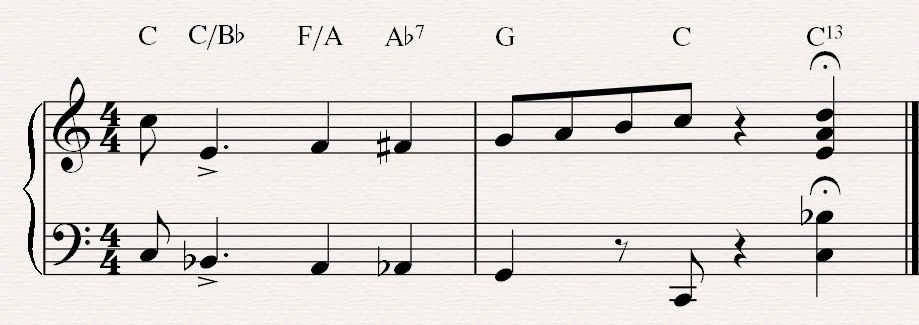
Key of C Major. (click to enlarge)

The ending's coolness,  I think, is a result of its simplicity (and its smooth contrary motion).

With some inferential chord labeling, you end up with strong structural chords (I, IV, and V). There's even a bit of augmented sixth chord action in there! (The Ab7 can be analyzed as a German chord, which I wrote about in this earlier post.)

The final fermata chord is somewhat variable, and it's where you can have fun adding in more interesting colors (my go-to is the #11 extension). Even the chord-quality can be modified, if you so desire (e.g. playing a C major-seventh chord rather than a C dominant-seventh chord).

This two-bar ending is a great thing to memorize and learn in all 12 keys, as it is very commonly used to end songs other than 'A' Train itself. (If someone instructs you to end a tune with the 'A' Train ending, this is what they're referring to.)

And that's about it... Have fun with the "caboose"!

Sunday, January 6, 2013

Augmented Sixth Chords (French)

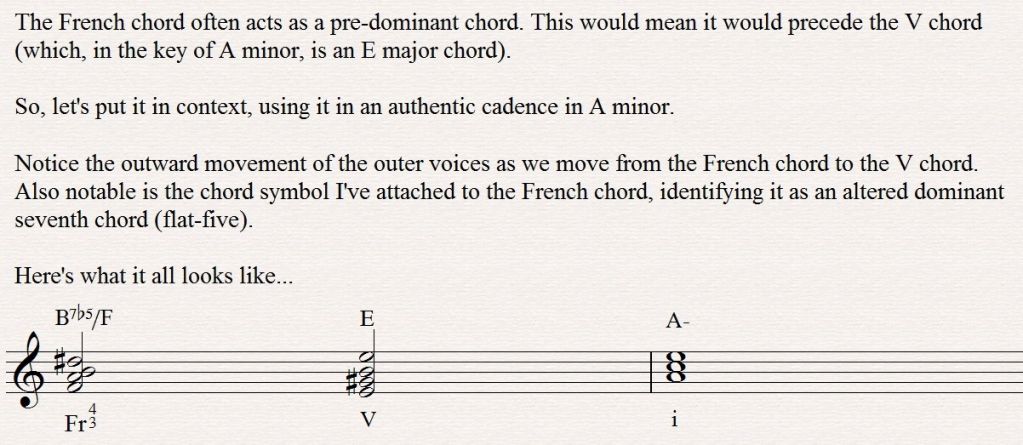
With this post, I conclude the Augmented Sixth Chords series. This final installment takes a look at the French chord, in all its glory. (Click the images to enlarge.)


Thursday, November 29, 2012

Two measures from a Passepied


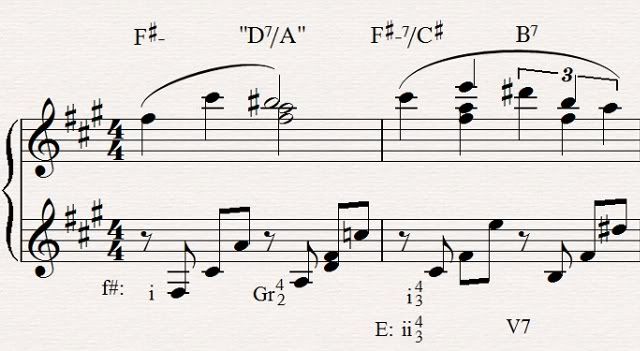
Here's a two-bar excerpt from the Passepied from Debussy's Suite Bergamasque. I found the harmonic progression interesting, so I typed it up and put the analysis in for your viewing pleasure. The two-bar phrase is repeated several times, eventually leading into a modulation to E major (hence the indication of a new key in the second bar).

This passage has a haunting quality to it, helped by the German augmented sixth chord. (For more on German sixths, click here.) Here's a link to this piece, linked with a time stamp which should take you to the first appearance of these two bars.

Tuesday, August 28, 2012

Augmented Sixth Chords (German)

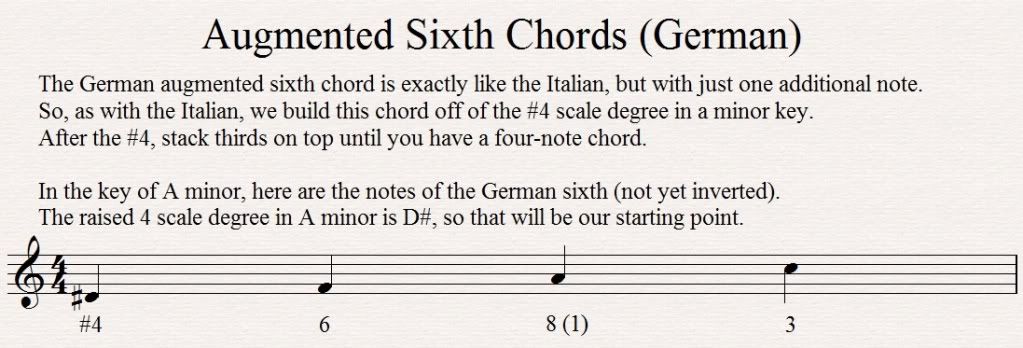
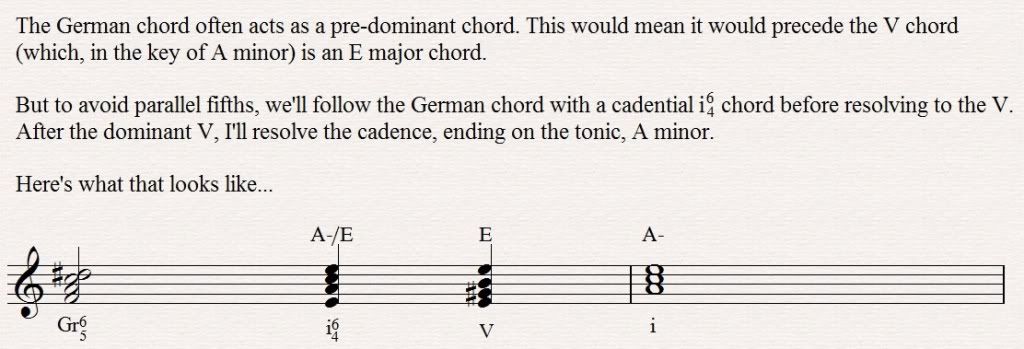
Here's the second installment of the ultra-popular Augmented Sixth Chords series. If you missed the first installment (about Italian sixths), be sure to check it out before learning about the German sixth!

(Or as the Germans call it, the __(click)___.)


And, that's that!

Thursday, August 9, 2012

Augmented Sixth Chords (Italian)

The Italian sixth chord is the simplest type of augmented sixth chord, and I will stick to just this type for this post. I decided to post this entire lesson as a series of images. You can click each image to enlarge it.


Related Posts Plugin for WordPress, Blogger...