Showing posts with label Jazz. Show all posts

Monday, September 14, 2015

Dominant inner-voice shift

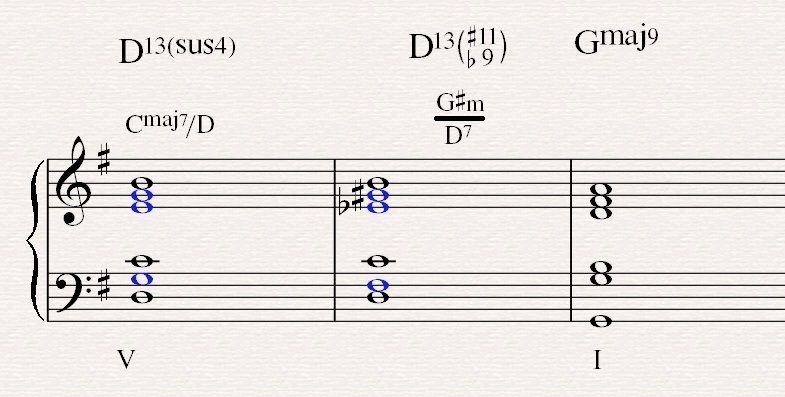
Voices in blue are the ones that move. Notice that the outsides
of the chord stay put, while the inner voices make small changes.

Here's a way to add some extra crunch to a dominant chord, with the 13th on the top.


A few reasons I like this harmonic shift:

  1. It all happens in the middle of the voicing. The outter voices stay put.
  2. The shifts are small (half steps), but the harmonic effect is big.
  3. The top two shifting voices in the right hand move in contrary motion, which is great.
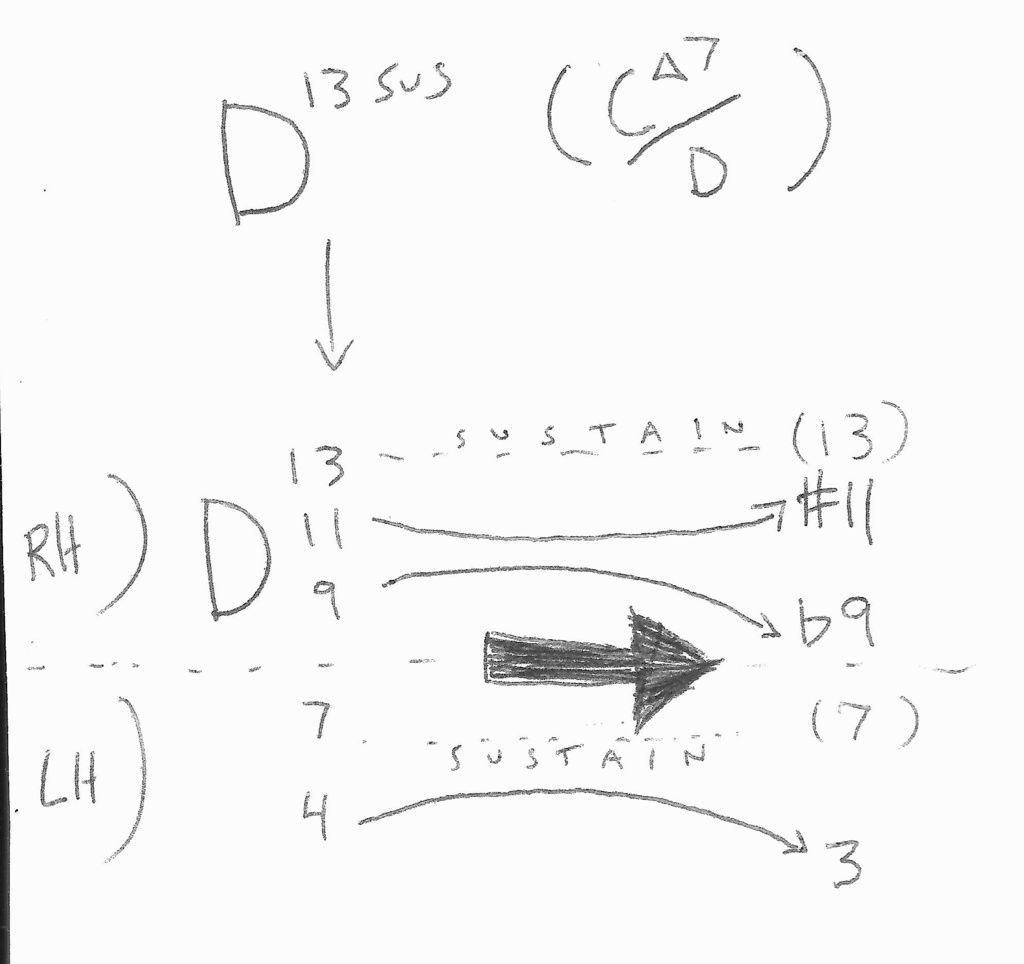
Handwritten break-down of this shift.

May your dominant chords be prolonged and extra-crunchy. Enjoy.

Sunday, August 23, 2015

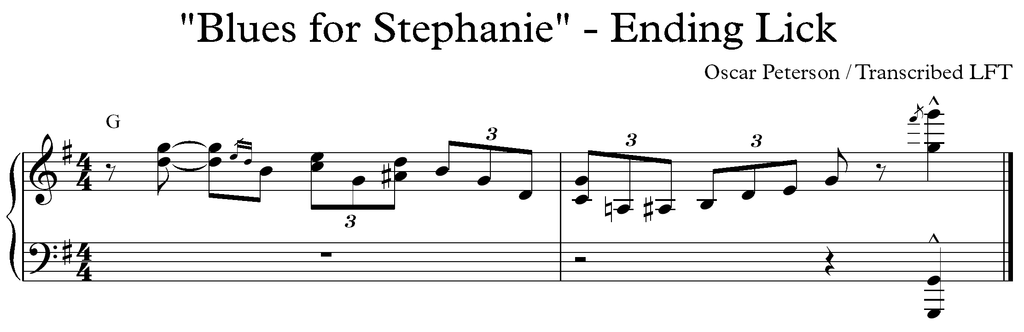
A Bluesy Oscar Peterson Lick ("Blues For Stephanie" ending)

LISTEN: Original Recording:


LISTEN: Original Recording, Slowed Down:


Transcription (click to enlarge):


Try it out for yourself!

Thursday, June 11, 2015

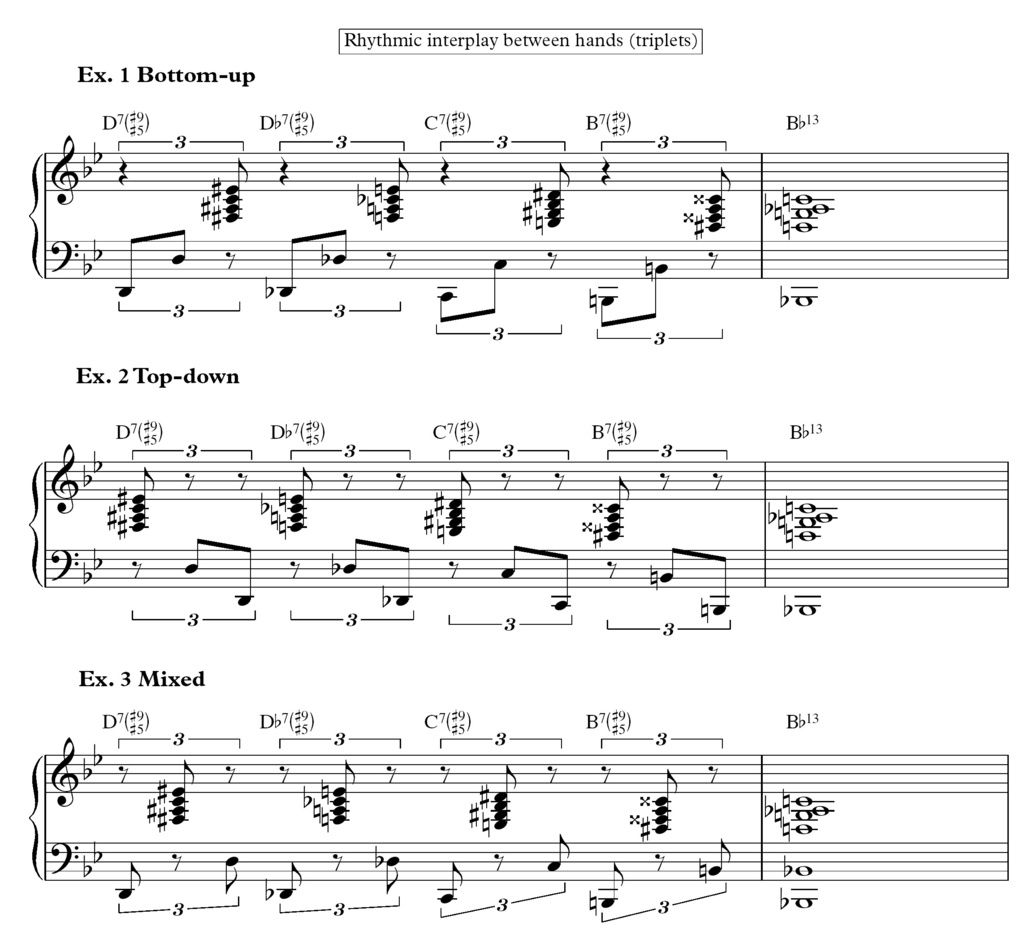
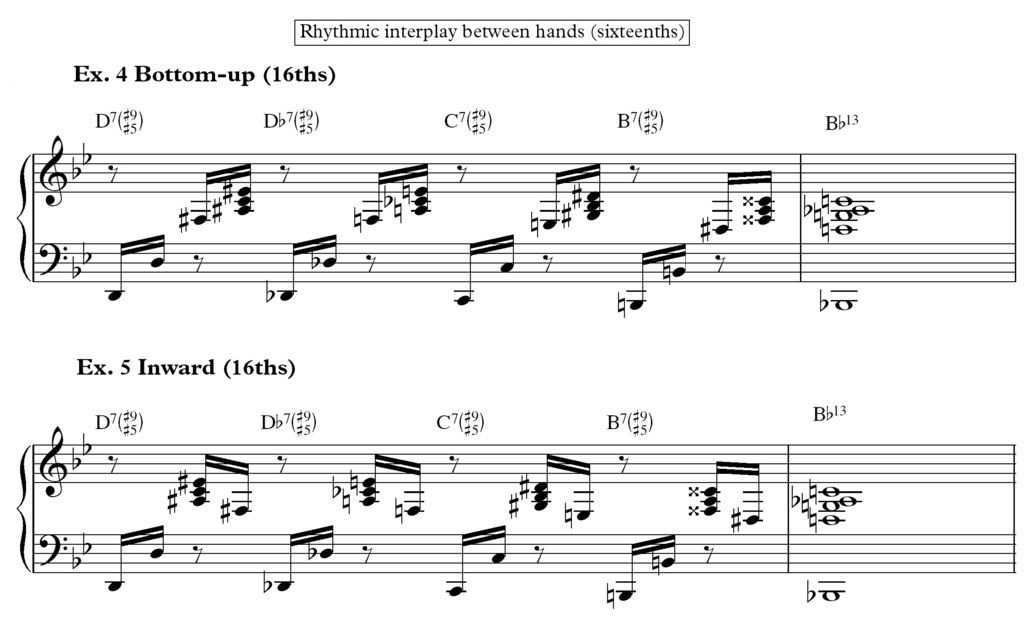
Rhythmic Interplay Between Hands

Being a former drummer, I sometimes approach the piano with a bias toward rhythm. Instead of going crazy with harmony, my preference oftentimes is to explore the musical statements that can be made by breaking up a voicing into chunks and altering rhythm.

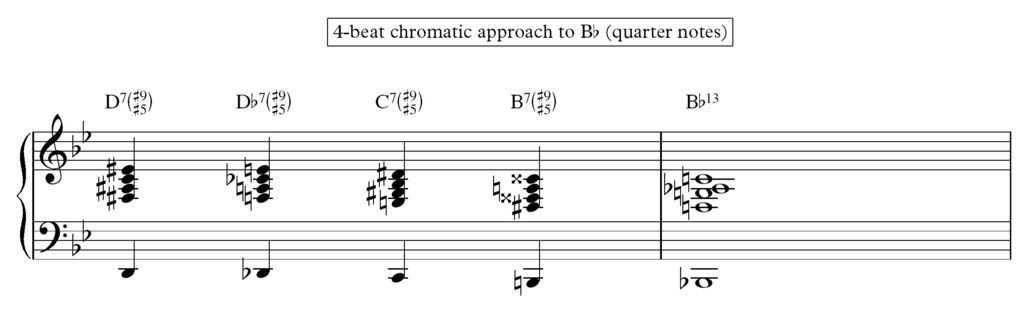
Let's look at this chromatically-descending set of chords to help illustrate how this might work. (Click images to enlarge. Click orange and white 'play' button below each example to listen.)

Boring quarter notes = Potential for some rhythmic fun


Since each chord-type is the same (and thus, the shapes of each chord are similar to one another), more attention can be given to the rhythms. I can break the chord into 3 'nodes' and play around with triplet rhythms:


OR, I can break the chord into 4 'nodes' to come up with busier 16th-note ideas:


To play these, my brain—I suspect—is thinking more as a drummer, in terms of "stickings" or drum rudiments, like diddles.

(E.g. Low bass clef notes followed by higher treble clef notes? Think L - R (left hand, right hand)
Two repeated notes? Think: diddle )

Listen to each variation and notice how each gives a slightly different musical effect. Play around with different interpolations of the chord/rhythms and see what you can come up with by thinking like a drummer!

For the full PDF of ideas contained in this post: Click here

Sunday, May 24, 2015

The Comedy and Music of Hans Groiner

Niche genre: Jazz piano comedy

The ability to look inwardly and poke fun at yourself or your craft, I think, is vital in order to stay sane and to keep from becoming deathly serious with your work. ("All work, no play makes Jack a dull boy...") After watching the antics of his character, Hans Groiner, it is clear to me that pianist Larry Goldings possesses this aptitude for humor.

Austrian pianist, Hans Groiner


Hans, in my mind, is the Victor Borge of jazz piano. He misinterprets and oversimplifies musical concepts with such conviction and seriousness that you might almost believe he isn't joking, until you are reminded by his ridiculous wig that this all must be a charade. Which it is, of course—a hilarious charade. For your entrance into the world of Hans Groiner, his jazz piano lesson is the best place to start:


Monk Expertise

Hans is a self-proclaimed expert on the music of Thelonious Monk (although he thinks Monk could have made some better note-choices in his music.) He flattens out all chromaticism from Monk's compositions, and in so doing, in his mind, improves the music a great deal. "[Monk's] note were very--some of them--very, uh, wrong-sounding and dissonant." Although Hans freely admits to disliking Monk's music, he could see "potential" in the music. Check it out:


Hans Groiner at Work - Live at Smalls

Seeing Hans talk to a camera in a YouTube music lesson or documentary is hilarious, but seeing him in action, performing his own concert at a legitimate jazz club constitutes another level of humor. This hilarious performance features Groiner on the accordion/piano, Jeff Ballard on drums,  and Joe Martin on bass. (Pretty good band mates for little old Hans!) The performance is split into three parts; here's the first part:


What's your favorite Hans Groiner quote/song?

Thursday, April 23, 2015

Walking Bass Lines on the Piano - Rhythmic Concepts

A huge benefit a piano player enjoys is the ability to play several musical lines simultaneously. Therefore, in the jazz idiom, it's possible for one piano player to fulfill the roles of not only the melodic/harmonic instruments (typically with the right hand), but also the bassist (in the left hand).

In the following video, I focus in on these left hand bass lines. These lines serve as a strong harmonic and rhythmic foundation. In and of itself, too, a bass line constitutes its own independent melody. (The harmonic progression used in the video is a simple C bluesprimary chords: C7, F7, and G7.)


Being an overall foundational component, bass lines are most often constructed with not much more than four well-placed notes per measure. That is to say, quarter notes are the rhythmic bread-and-butter of a sturdy bass line.

Once a strong quarter-note groove has been achieved, though, certain variations can be thrown into the mix in order to spice up the music and add a heightened sense of excitement/momentum to the groove. Here are some of the main rhythmic ideas that I demonstrate in the video:
  1. Instead of 4 quarter notes per bar, try using 6 quarter-note triplets to fill up a 4/4 measure.
  2. Experiment with different groupings of these 6 notes. (e.g. Two groups of 3 or Three groups of 2)
  3. Eighth note or eighth-note triplets can be played to propel the line toward a target note that you'd like to emphasize. (e.g. Eighth-note triplets preceding beat 4: "1, 2, 3-na-ne, 4")
  4. Once the RH joins in with your LH's bass line, experiment with placing faster right hand rhythms (triplets and sixteenth notes) atop the LH's quarter notes.
These are only a few ideas to get the ball rolling. Check out the Application Examples and "Putting it All Together" clips within the video for some ideas on how these concepts look and sound on the piano. Of course, the joy of music improvisation is that the sky is the limit—see what other ideas you can come up with, and have fun making your own walking bass lines!

Tuesday, August 26, 2014

"Drop 2" Chord Voicing Technique

The "Drop 2" chord voicing technique is a common arranging/composing/piano trick. It's a great way to voice a chord for a horn section, or if you're a piano player, it's a slick way of creating strong 4- or 5-note voicings.

It's simple:

1) Start with a 4-note chord that exists all within an octave. (This may be a chord in root position, but may also be a different inversion of a chord, or some other type of cluster.)
2) Identify the second highest note (the "2" of "Drop 2").
3) Move this note down an octave.

That's it!

Here's a step-by-step video showing the process:


A Handful of Major Chord Voicings (with colorful illustrations) [Part 2 of 2]

In Part 1 of this series, the handful of major chord voicings was introduced along with an accompanying A/V example.

Now, in Part 2, each voicing will be colorfully broken down.


Color-Coding Chord Tones


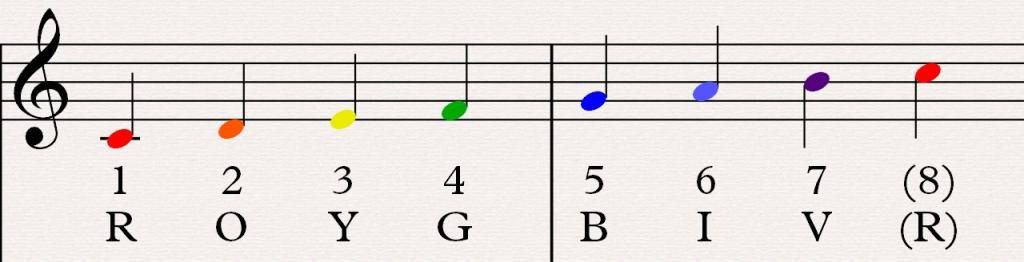
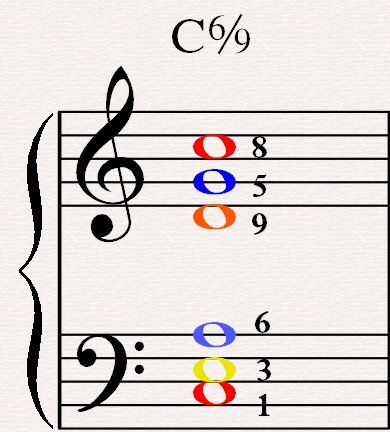
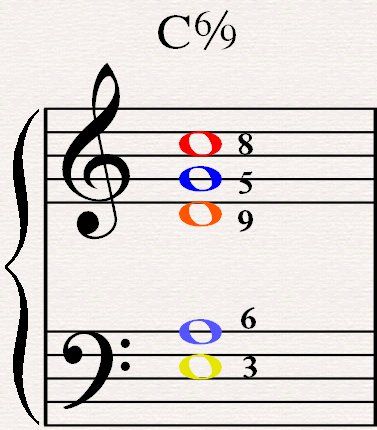
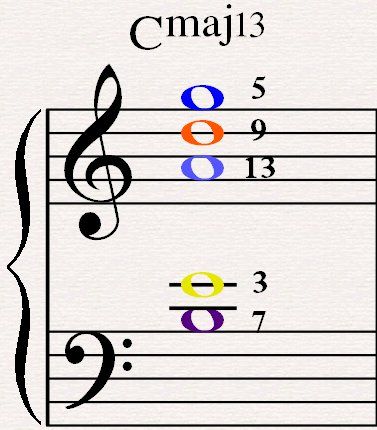
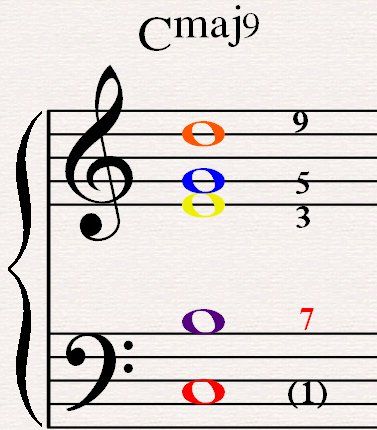
I will show each voicing notated on a grand staff, using a color-coded system. In the system, each scale degree (in these case of C major) is assigned a color, following the order of ROYGBIV. Since there are 7 notes in a scale, and 7 distinct colors in the visible light spectrum, this works out nicely. (This colorful choice of mine was inspired by this very interesting article about the link between Music and Color.)

C major scale, in colors.

*Please note that the people I attribute the following voicings to (and therefore the labels I assign each one), are by no means the originators of a particular voicing. Rather, they are the musicians/educators from whom I personally learned each voicing. (I will link to the relevant sources as we go along.)

Five Colorful Voicings


1) Symmetrical "Martin" Cmaj13 (via Peter Martin)

  • Symmetry in intervals: 3rd, 4th, 4th, 4th, 3rd
  • Very similar to the next voicing (Tristano), but more colorful because it contains the 7th
  • LH contains a minor chord in first inversion, RH contains a major chord in second inversion


2) "Tristano" Cmaj6/9 (a la Lennie Tristano)


  • Top four notes are spaced out by a 4th
  • Root is doubled, appearing on the very bottom and top of the voicing
  • Tristano often used this by "planing" this shape, moving it up or down chromatically


3) Rootless "A Position" Quartal Voicing, Cmaj6/9 (via Earl MacDonald)


  • 3rd on bottom (root on top)
  • Basically the same as Tristano's voicing, but without the root doubled in the LH


4) "B Position" Quartal Voicing, Cmaj13 (via Earl Macdonald)


  • 7th on bottom (5th on top)
  • Rootless


5) "Drop 2" Cmaj9


Final Remarks


What to do with all of this information? If you happen to latch on to the sound/feel of one or two of these, take a second to figure it out on the piano. Divide the notes between hands however is most comfortable to you (in some 5-note cases, it may be preferable to put three notes in the LH, two in the RH, but you might prefer it the other way around). From there, continue around the Cycle of Fourths (or Fifths), constructing the voicing slowly and carefully.

Happy voicing!

A Handful of Major Chord Voicings (with colorful illustrations) [Part 1 of 2]

Prepare yourself to play some of these pretty chords. In general, they more-or-less all share the following characteristics:

  • Mostly quartal (stacked in fourths)
  • Contain extensions such as the 6th (13th) or 9th
  • Relatively equal spacing between notes
  • Sound really great
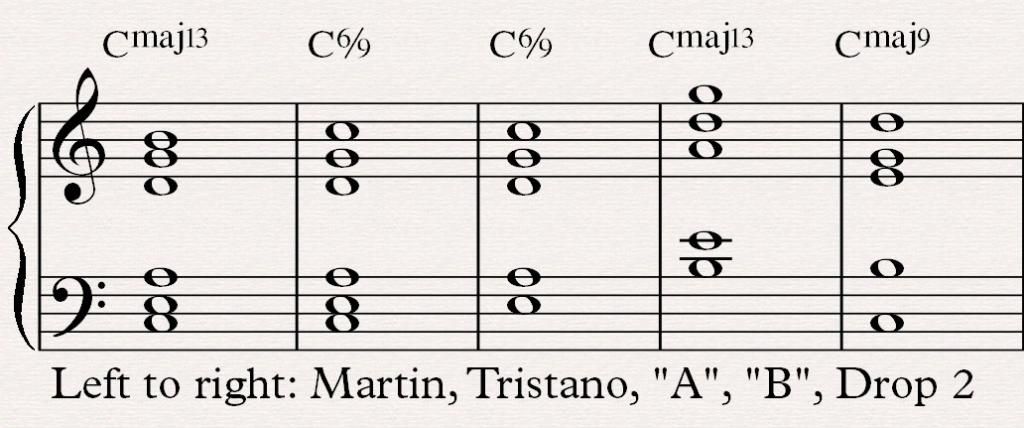
Here they are all together on one line of music, with an accompanying video (listen for the subtle differences between each voicing):

(These labels I assigned each one will be explained in Part 2.)


In the next installment [Part 2 of 2], I will show you how to construct each of these voicings.

Thursday, January 30, 2014

'A' Train Ending

Months ago, I wrote up a little post about the classic "Take the 'A' Train" introduction, so I thought I ought to also write a bit about the tune's equally classic ending (its caboose?).

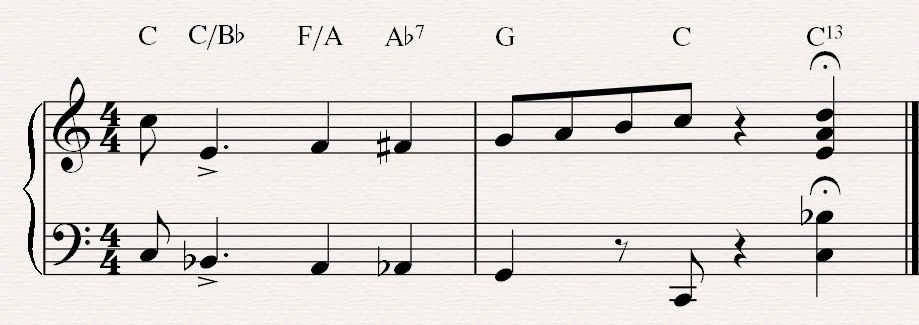
Here it is (in its most basic form), with some approximations of chord symbols above the staves:

Key of C Major. (click to enlarge)

The ending's coolness,  I think, is a result of its simplicity (and its smooth contrary motion).

With some inferential chord labeling, you end up with strong structural chords (I, IV, and V). There's even a bit of augmented sixth chord action in there! (The Ab7 can be analyzed as a German chord, which I wrote about in this earlier post.)

The final fermata chord is somewhat variable, and it's where you can have fun adding in more interesting colors (my go-to is the #11 extension). Even the chord-quality can be modified, if you so desire (e.g. playing a C major-seventh chord rather than a C dominant-seventh chord).

This two-bar ending is a great thing to memorize and learn in all 12 keys, as it is very commonly used to end songs other than 'A' Train itself. (If someone instructs you to end a tune with the 'A' Train ending, this is what they're referring to.)

And that's about it... Have fun with the "caboose"!

Thursday, January 9, 2014

Dissecting an Oscar Peterson lick ("Night and Day")

Last semester, I was in a "Jazz Improv" course, which taught improvisation through the study of standard melodic devices, idiomatic scales, and listening/transcription projects. For one transcription assignment, I chose an Oscar Peterson solo on the song "Night and Day." I chose O.P. because I love how he develops ideas and structures solos, all with with his signature touch and impeccable sense of time.

A word on transcription

Transcription can be useful for finding lines that you like and integrating them into your own vocabulary, verbatim. But what I like to do, rather than memorize and regurgitate a line exactly, is to identify lines that sound good to me, and then really dissect them and try to figure out why they sound good. (Maybe it's the rhythm that I like, or maybe it's the contour of the melodic line, or maybe it's the use of space, etc.)

And after listening to plenty of solos from my favorite players, over time, I start to see the 'common denominators' —what sorts of musical qualities tend to resonate with me?

From there, I can work on integrating those qualities (not necessarily the exact line verbatim) into my playing. That way, my style is influenced and informed by my musical role models, but my playing is still unique and 'my own.'

The lick

So let's get back to Oscar Peterson and look at just a couple measures from the "Night and Day" solo (click to enlarge):

Original O.P. lick, with target notes in blue.
After spending some time analyzing the line, I took an inventory of the passage's most obvious characteristics:
  • Static harmony (it all occurs over one chord, Ebmaj7)
  • Rhythmic repetition (two eighth notes, four sixteenth notes)
  • Contour of line: large leaps up, sprinkled with small movements down (like taking three steps up a staircase, one step down, three more steps up, another down, etc.)
  • Enclosure
Enclosure and embellishment

Let's focus in on the last bullet point: enclosure. To do so, I'm going to sort of reverse-engineer the line so that we can understand exactly how the enclosure is working. This process is essentially a Schenkerian method of analysis. (Heinrich Schenker said that a piece of music can be reduced down to its most basic elements, and from this structural base, a composer 'composes out' (Auskomponierung) by way of elaboration and embellishment.)

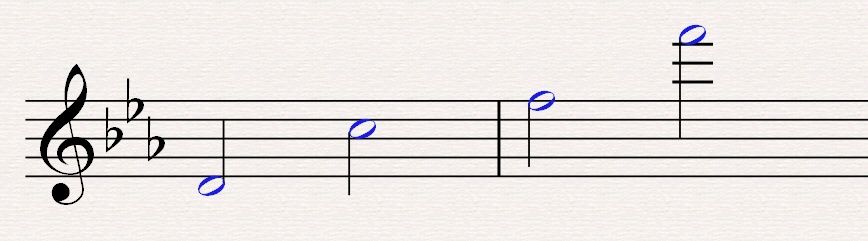
First, we can reduce the whole line into four structural half notes (highlighted in blue, Fig. 1).

Figure 1: Structural 'target' notes.
From there, you can think of the other notes as embellishments of these primary notes, achieved by way of approaching the target note. A common way to approach (precede) a note is through enclosure: playing the notes just above and below the target note.

I have notated this concept in Fig. 2, with slightly condensed rhythmic activity (flattening the first measure into all eighth notes). It works by using two "above" notes and one "below" note to connect beat 1 with the target note on beat 3.

This idea from beats 1-2 is sequenced (repeated up a fourth) on beats 3-4, and it is this repetition that gives the line a sense of structure. The second measure introduces a new connective idea, an ascending Eb major 7 arpeggio up to the F.

Figure 2: Simplified line, with 3-note approaches to target notes (labelled in bar 1).
To get from Fig. 2 (condensed version) to O.P.'s actual line, we add a little bit more embellishment to beats 2 and 4 of the first measure. This is done by adding 'upper neighboring tones,' achieved by increasing the rhythmic activity from eighth notes to sixteenths. (For example, on beat 2, we change Db - B [eighths] to Db - D - Db - B [sixteenths]. The 'D' in this case would be the upper neighbor).

And... voila! We arrive at the original lick (finally!).

The takeaway

Of course all of this analysis is rather long-winded and perhaps reeks of academic stuffiness. Surely, while playing his solo, Oscar Peterson wasn't consciously thinking, "Okay, that was a structural note... now let's connect it to beat 3 with a three-note enclosure. Oh, that sounded nice; let me do that again, this time up a fourth..." (Well, maybe he was...)

The point of this all, then, is to identify and analyze techniques and devices, and 'shed' them in the practice room. Work on them to the point that you no longer need to think through all those theoretical steps. In other words, master the technique; internalize it.

For instance, from these couple measures, I would hone in on the idea of enclosure, and I'd try to figure out how to apply it to my own playing. (I might start by looking at a standard jazz head and identifying a melody note as my target note. Then, I could practice enclosing that target note.)

This is just one way to begin applying a new concept. The point is to think of creative ways to apply new ideas, and to practice the techniques until a level of familiarity/comfort is reached.

Once you really own an idea, it's yours, and you will then gain insight into how you might apply the idea in other contexts, and how you might adapt the idea to meet new musical challenges. (And that's a lot of fun.)

Sunday, September 8, 2013

'A' Train Intro

Billy Strayhorn's composition "Take the 'A' Train" was the Duke Ellington orchestra's signature tune. The piece's introduction is instantly recognizable and prepares the listener for the rest of the classic composition.

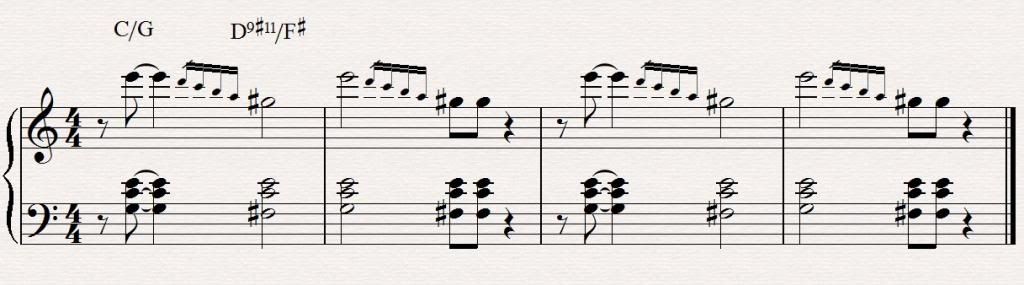
Here's a transcription of the famous 4-bar intro (click to enlarge):


It is comprised of just two chords. The first chord is a second-inversion C major chord, and the second chord can be thought of as a first-inversion D9#11 (though it lacks the root). Using an enharmonic spelling, it could also be thought of as a third-inversion Ab7#5, but the D9 interpretation seems more fitting, if slightly incorrect, considering the D7#11 chords found later in the head.

These two chords are covered by the left hand, and the right hand plays melodically above. The right hand covers the span of a minor sixth, connecting E to the G# below with a glissando. The minor sixth is notable in that it is just a half step smaller than a major sixth, which is found in the first few notes of the tune's melody (G up to E). The introduction's minor sixth, in a sense, creates tension (as does the whole-tone color produced by the #11 chord), which is subsequently resolved on bar 1 of the head.

Have a listen to Duke Ellington and his orchestra playing 'A' Train (begins at 0:12):

Thursday, June 27, 2013

Bebop Scales

Around the 1940s, the jazz world saw the emergence of a style known as "bebop." The style is characterized by fast tempos and an advanced harmonic vocabulary, and it places significant importance on the improvisatory element of music.

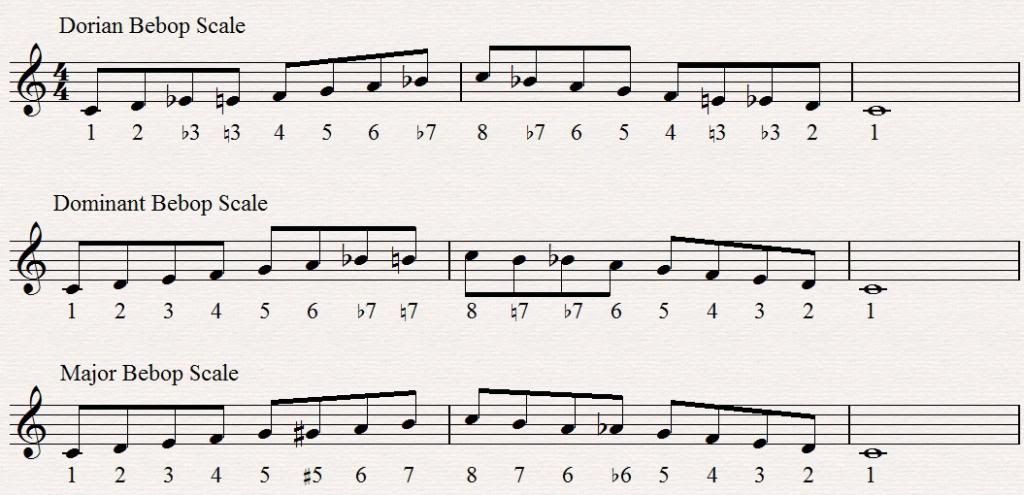
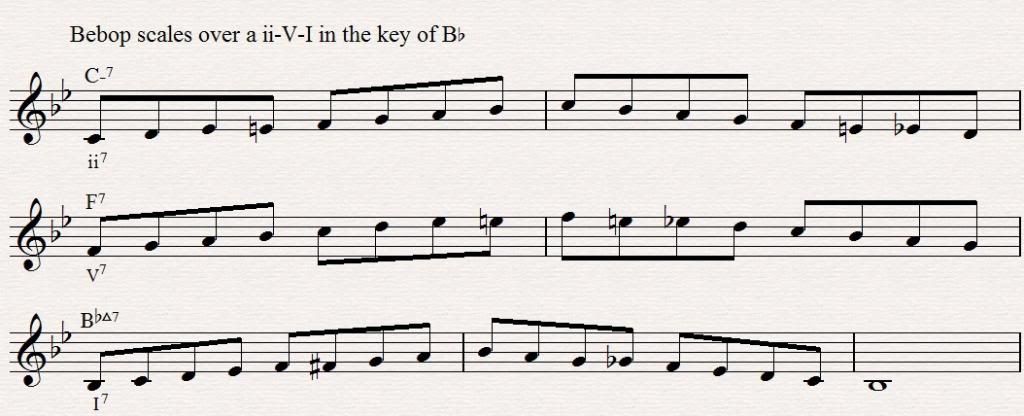
In order to improvise in this jazz style, it is helpful to first learn the idiomatic harmonic "language" (vocabulary). So, here are a few bebop scales (each beginning on C) which can be practiced in all keys, and then applied to your soloing.

Three bebop scales

The scales are constructed by taking a traditional scale/mode and altering it slightly by adding one chromatic passing tone between certain scale degrees. This additional note results in an eight-note scale (rather than the normal seven-note scale), which is handy when dealing with 4/4 time signatures. The scale, played as eight eighth notes, perfectly fills up a measure, and helps the soloist more easily place chord tones on the strong part of the beat.

In order to apply these scales, consider a 2-5-1 progression. Use the Dorian bebop scale on the 2, Mixolydian bebop on the 5, and Major bebop on the 1. (You'll notice that the Dorian bebop scale contains the same notes as the Mixolydian bebop scale. Indeed, they are both modes of the same scale.) The example below applies these scales to a 2-5-1 in B-flat major.

Dorian, Mixolydian, Major

Saturday, March 30, 2013

Jazz Vocab: Beethoven figure

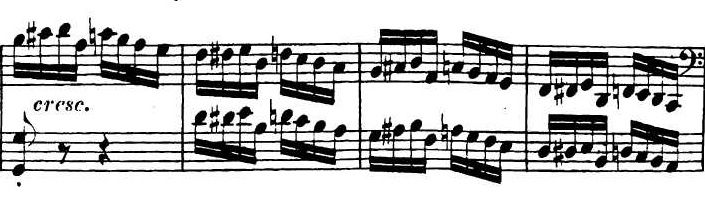
This is the first of what I intend to be many "Jazz Vocabulary" posts. We're kicking it off with some Ludwig van Beethoven. I played his Sonata No. 16 in G Major, Op. 31 (Movement 1) last spring, and within the piece, there is a recurring melodic idea (first stated in the key of G major) that works well as a jazz pattern.

The Figure

 Here's how it appears in the sonata, in the key of G Major:

(RH: treble clef, LH: bass clef)

I liked the shape of this line so much that I decided to integrate it into my jazz vocabulary. It's easy to construct and figure out in any key: It begins on the tonic, approaches the major third by a half step, encloses the tonic, moves stepwise down to the 5th of the scale, continues to the 6th with a chromatic passing tone, encloses the 4th, then continues down stepwise until making it "home" to the tonic.

Applying the Figure

It can be used over major chords, and is easily repeatable (as Beethoven demonstrates in his sonata), given you are using a proper fingering. For instance in the key of G, I make sure my thumb is landing on the root (G) and the fifth (D) of the scale. This ensures that the fingers are in position to repeat the pattern for the next octave below.

Practicing the Figure

Take this pattern around the circle of fifths all 12 major keys. You'll find that slightly different fingerings will be necessary for each key, but the adjustments are only minor. Many keys may use identical fingerings for this pattern. To get you started, I created a sheet with the pattern in the keys of C, F, Bb, and Eb. At the end of the sheet, I also included the pattern in the original key of G major. Fingerings have been included, but they are only suggestions, as your fingers might prefer something else.

Video

In this video, I play the pattern first in C major a few times, then I continue to take it around the cycle, as per the sheet.


Links

Download the worksheet: Beethoven Worksheet
Watch the video again: Watch again

Monday, December 24, 2012

Video summary: Hal Galper: The Illusion of an Instrument

Hal Galper is a jazz pianist, composer, and bandleader who has worked with such musicians as Cannonball Adderly, Chet Baker, and John Scofield. In addition to his great renown in the performance realm, he is also widely recognized as a tremendous educator.

Many of his ideas and musical advice can be accessed easily, thanks to the power of the internet and the bounty of YouTube.

One video, titled "The Illusion of an Instrument," caught my eye, and it turned out to be a compelling 9-minute mini-lesson which helped draw a connection between music and the mind. As I watched, I took notes and paraphrased the big points:
  1. Music-making is a process-oriented event (not information-oriented).
  2. The components of performance are:
    • Mind
    • Body
    • Emotions
  3. George Kochevitsky: In order to play something, you must be able to hear it first.
  4. André Watts: [Music-making] all depends on the intensity of your concentration and the vividness of your aural imagination.
  5. Playing precisely what you hear in your mind is a matter of strengthening the aural impulse in your brain. So, instead of simply imagining a musical line in your head, or instead of singing the line, think of SCREAMING the line in your head. This will strengthen the aural impulse in your brain, and it will add a level of confidence and clarity to your playing.

For more elaboration, watch this thing.

Sunday, September 9, 2012

The Genius of Monk

"A genius is the one most like himself."
Thelonious Monk

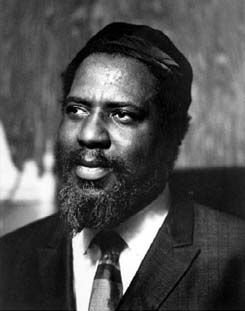
For years now, this famous document filled with curious scribbles, titled "MONK'S ADVICE," has been making its rounds on the internet. (One blogger discusses Thelonious Monk and some of the document's background here.) I've noticed the document pop up time and time again, and each time I read it, I get something new out of it. Today, the "genius" quote popped out at me.

Throughout life, we are constantly influenced by outside sources. We may emulate a personal hero, mimic a musician's melody, or draw knowledge from a famous quote (like right now, for example). Through imitation and emulation, we shape ourselves (musically and personally).

Outside influences push and pull us in many different directions. Sometimes these forces challenge us and change us for the better; other times they confuse us and throw us off of our path. At these times, I think it's important to look inwardly and go with your gut. Or, for you saps out there, go with your heart. Stick to your essence.

Alternatively, if you prefer rhymes:
"Today you are You; that is truer than true. There is no one alive who is Youer than You."
—Dr. Seuss
Musically, this means you should pursue the music that interests you the most. Do your best to branch out and become versatile, but realize that it's okay if not everything gels perfectly with your style. Realize that you have your own style.

For Monk, this meant embracing his own crazy, unorthodox style: percussive, fragmented, and completely unique.


Related Posts Plugin for WordPress, Blogger...