Showing posts with label Voicing. Show all posts

Monday, September 14, 2015

Dominant inner-voice shift

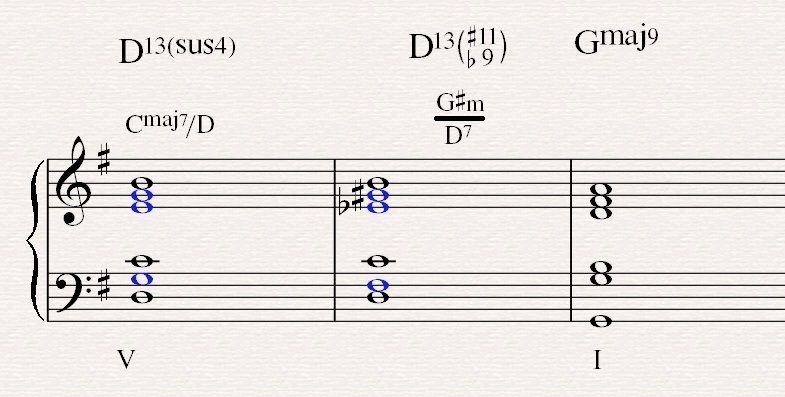
Voices in blue are the ones that move. Notice that the outsides
of the chord stay put, while the inner voices make small changes.

Here's a way to add some extra crunch to a dominant chord, with the 13th on the top.


A few reasons I like this harmonic shift:

  1. It all happens in the middle of the voicing. The outter voices stay put.
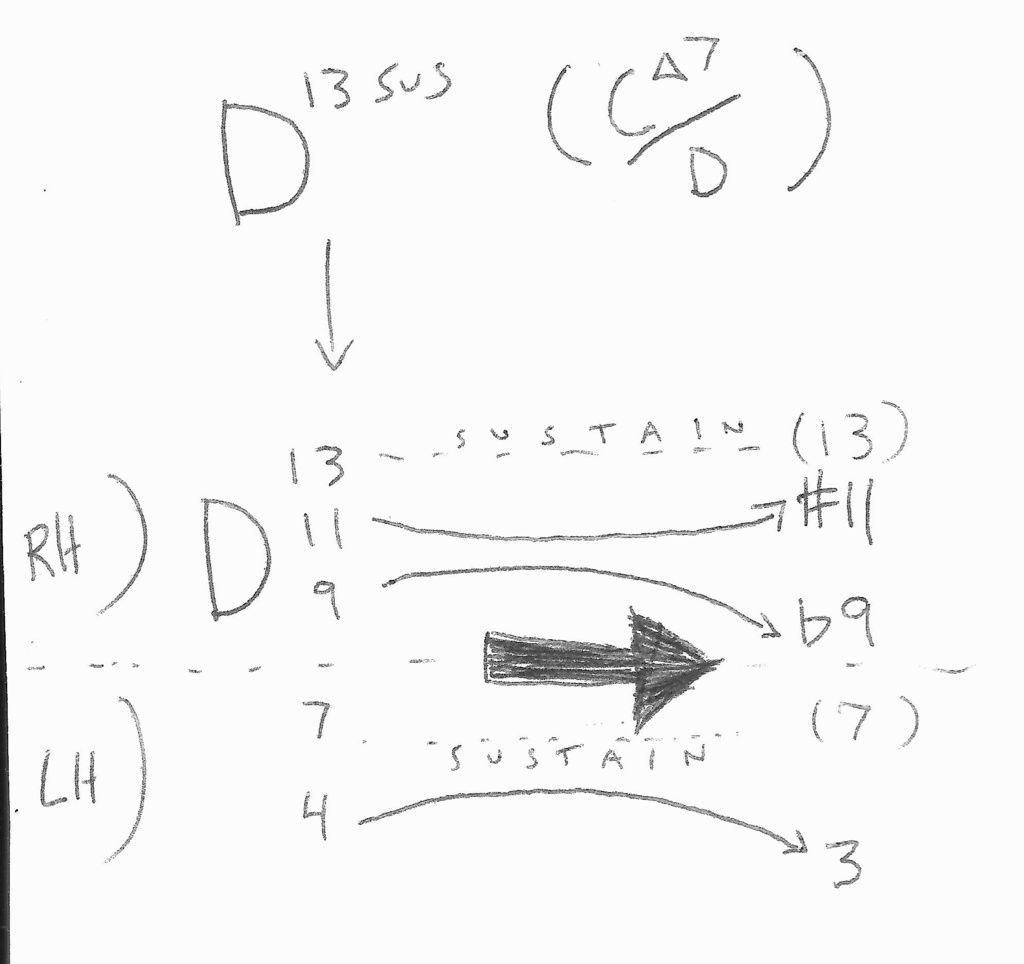
  2. The shifts are small (half steps), but the harmonic effect is big.
  3. The top two shifting voices in the right hand move in contrary motion, which is great.
Handwritten break-down of this shift.

May your dominant chords be prolonged and extra-crunchy. Enjoy.

Thursday, June 11, 2015

Rhythmic Interplay Between Hands

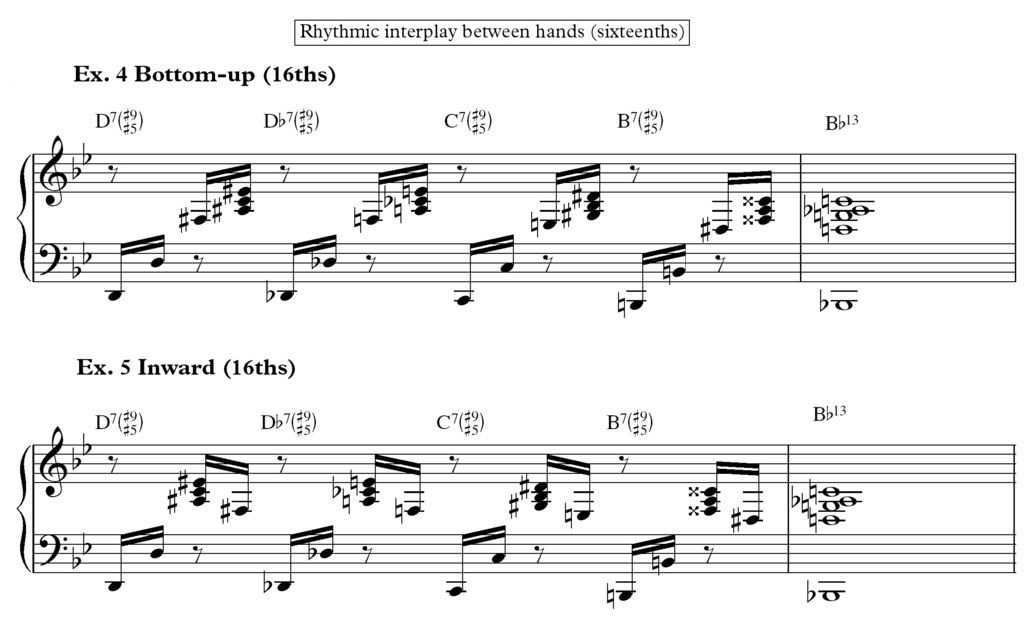
Being a former drummer, I sometimes approach the piano with a bias toward rhythm. Instead of going crazy with harmony, my preference oftentimes is to explore the musical statements that can be made by breaking up a voicing into chunks and altering rhythm.

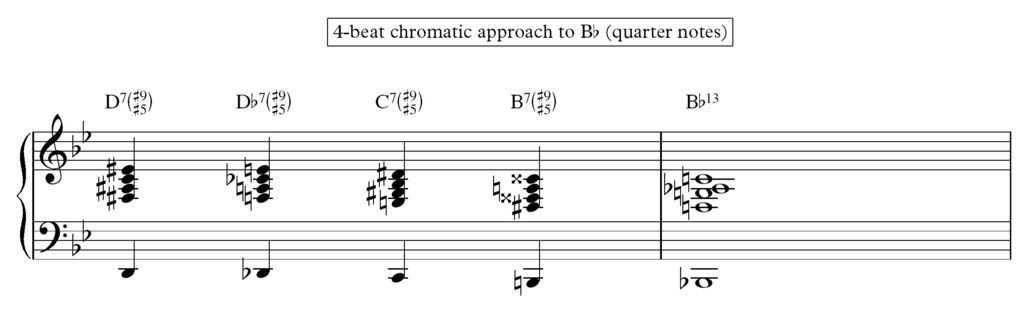
Let's look at this chromatically-descending set of chords to help illustrate how this might work. (Click images to enlarge. Click orange and white 'play' button below each example to listen.)

Boring quarter notes = Potential for some rhythmic fun


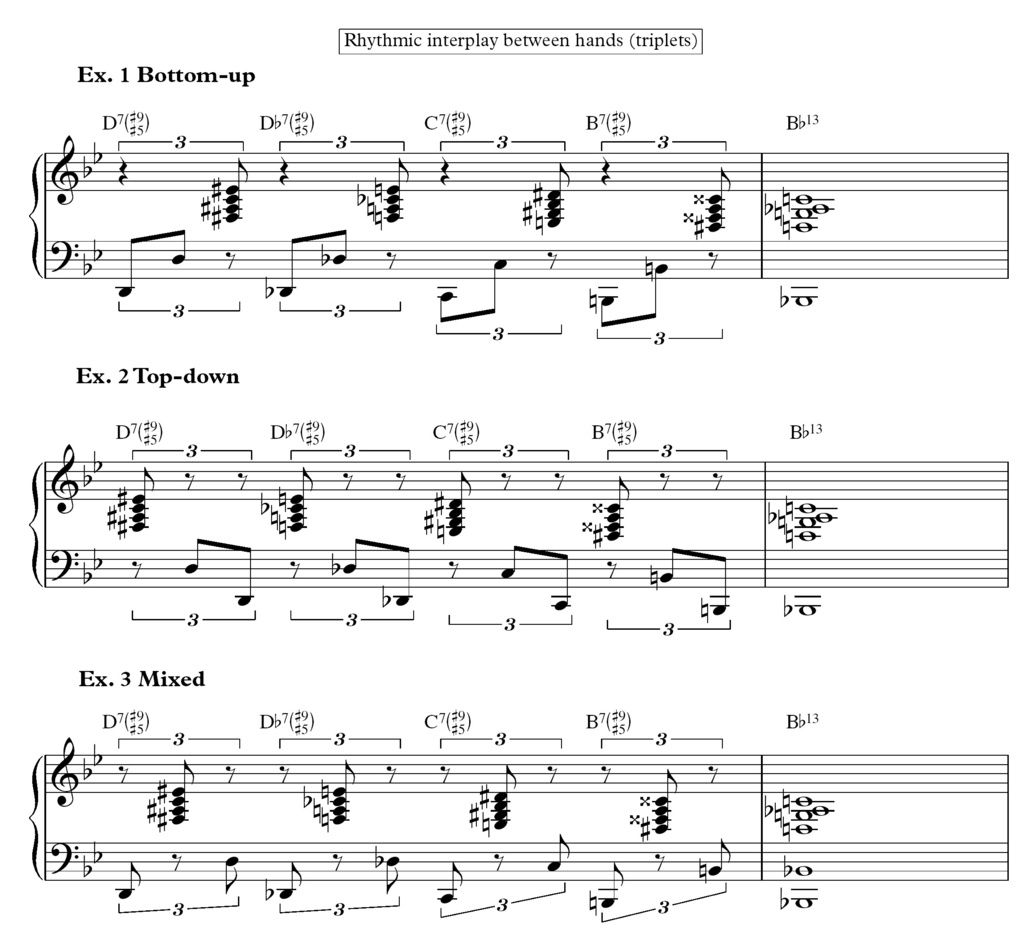
Since each chord-type is the same (and thus, the shapes of each chord are similar to one another), more attention can be given to the rhythms. I can break the chord into 3 'nodes' and play around with triplet rhythms:


OR, I can break the chord into 4 'nodes' to come up with busier 16th-note ideas:


To play these, my brain—I suspect—is thinking more as a drummer, in terms of "stickings" or drum rudiments, like diddles.

(E.g. Low bass clef notes followed by higher treble clef notes? Think L - R (left hand, right hand)
Two repeated notes? Think: diddle )

Listen to each variation and notice how each gives a slightly different musical effect. Play around with different interpolations of the chord/rhythms and see what you can come up with by thinking like a drummer!

For the full PDF of ideas contained in this post: Click here

Tuesday, August 26, 2014

"Drop 2" Chord Voicing Technique

The "Drop 2" chord voicing technique is a common arranging/composing/piano trick. It's a great way to voice a chord for a horn section, or if you're a piano player, it's a slick way of creating strong 4- or 5-note voicings.

It's simple:

1) Start with a 4-note chord that exists all within an octave. (This may be a chord in root position, but may also be a different inversion of a chord, or some other type of cluster.)
2) Identify the second highest note (the "2" of "Drop 2").
3) Move this note down an octave.

That's it!

Here's a step-by-step video showing the process:


A Handful of Major Chord Voicings (with colorful illustrations) [Part 2 of 2]

In Part 1 of this series, the handful of major chord voicings was introduced along with an accompanying A/V example.

Now, in Part 2, each voicing will be colorfully broken down.


Color-Coding Chord Tones


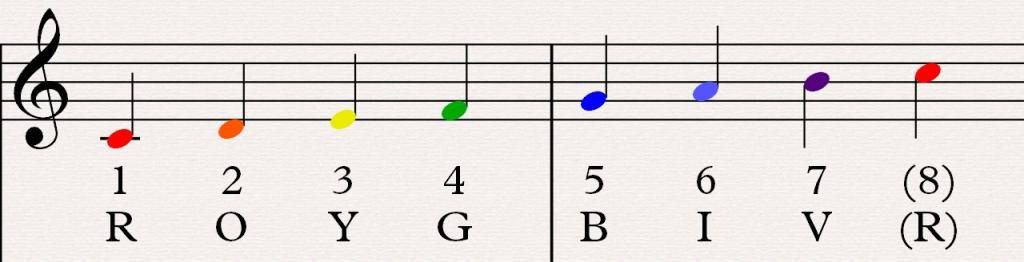
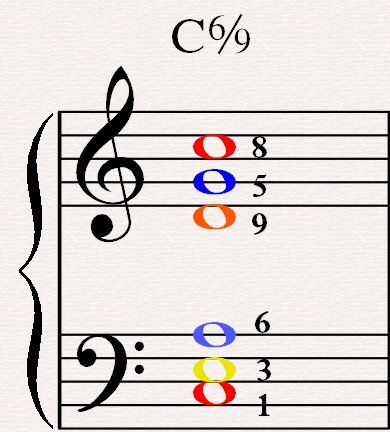
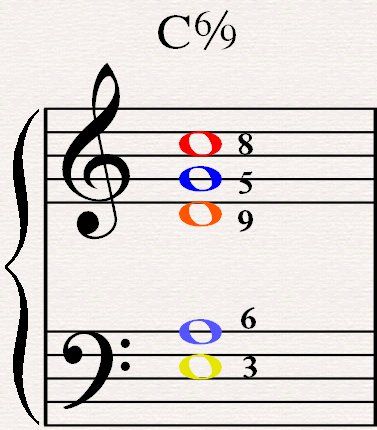
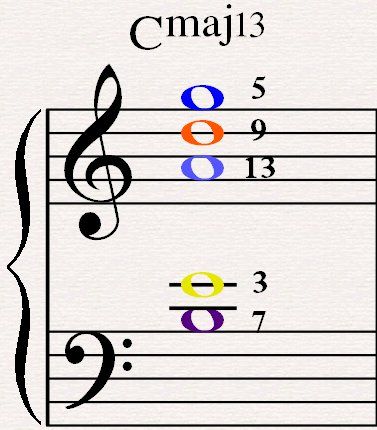
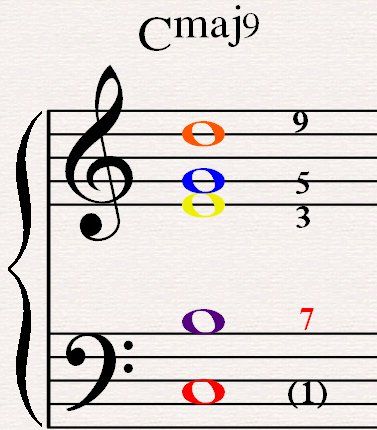
I will show each voicing notated on a grand staff, using a color-coded system. In the system, each scale degree (in these case of C major) is assigned a color, following the order of ROYGBIV. Since there are 7 notes in a scale, and 7 distinct colors in the visible light spectrum, this works out nicely. (This colorful choice of mine was inspired by this very interesting article about the link between Music and Color.)

C major scale, in colors.

*Please note that the people I attribute the following voicings to (and therefore the labels I assign each one), are by no means the originators of a particular voicing. Rather, they are the musicians/educators from whom I personally learned each voicing. (I will link to the relevant sources as we go along.)

Five Colorful Voicings


1) Symmetrical "Martin" Cmaj13 (via Peter Martin)

  • Symmetry in intervals: 3rd, 4th, 4th, 4th, 3rd
  • Very similar to the next voicing (Tristano), but more colorful because it contains the 7th
  • LH contains a minor chord in first inversion, RH contains a major chord in second inversion


2) "Tristano" Cmaj6/9 (a la Lennie Tristano)


  • Top four notes are spaced out by a 4th
  • Root is doubled, appearing on the very bottom and top of the voicing
  • Tristano often used this by "planing" this shape, moving it up or down chromatically


3) Rootless "A Position" Quartal Voicing, Cmaj6/9 (via Earl MacDonald)


  • 3rd on bottom (root on top)
  • Basically the same as Tristano's voicing, but without the root doubled in the LH


4) "B Position" Quartal Voicing, Cmaj13 (via Earl Macdonald)


  • 7th on bottom (5th on top)
  • Rootless


5) "Drop 2" Cmaj9


Final Remarks


What to do with all of this information? If you happen to latch on to the sound/feel of one or two of these, take a second to figure it out on the piano. Divide the notes between hands however is most comfortable to you (in some 5-note cases, it may be preferable to put three notes in the LH, two in the RH, but you might prefer it the other way around). From there, continue around the Cycle of Fourths (or Fifths), constructing the voicing slowly and carefully.

Happy voicing!

A Handful of Major Chord Voicings (with colorful illustrations) [Part 1 of 2]

Prepare yourself to play some of these pretty chords. In general, they more-or-less all share the following characteristics:

  • Mostly quartal (stacked in fourths)
  • Contain extensions such as the 6th (13th) or 9th
  • Relatively equal spacing between notes
  • Sound really great
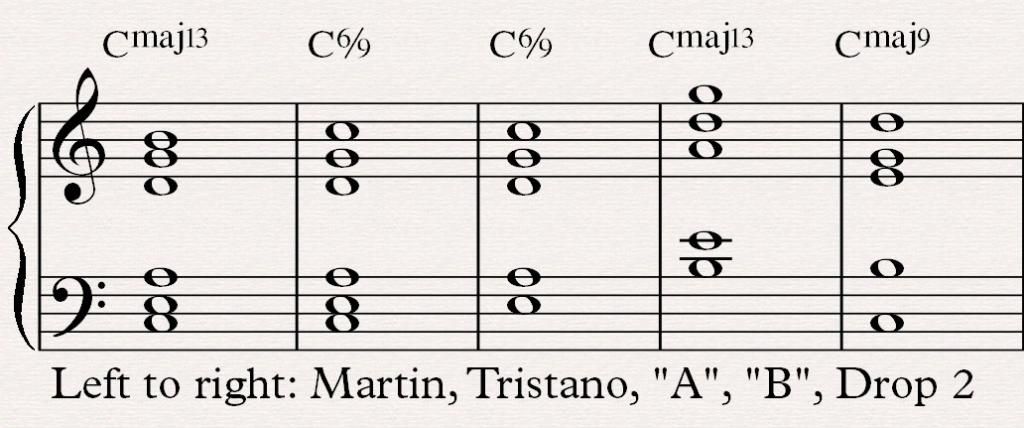
Here they are all together on one line of music, with an accompanying video (listen for the subtle differences between each voicing):

(These labels I assigned each one will be explained in Part 2.)


In the next installment [Part 2 of 2], I will show you how to construct each of these voicings.
Related Posts Plugin for WordPress, Blogger...