Showing posts with label Duke Ellington. Show all posts

Thursday, January 30, 2014

'A' Train Ending

Months ago, I wrote up a little post about the classic "Take the 'A' Train" introduction, so I thought I ought to also write a bit about the tune's equally classic ending (its caboose?).

Here it is (in its most basic form), with some approximations of chord symbols above the staves:
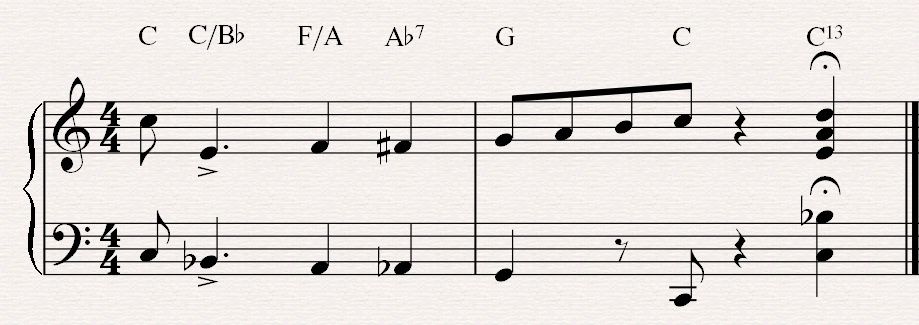
Key of C Major. (click to enlarge)

The ending's coolness,  I think, is a result of its simplicity (and its smooth contrary motion).

With some inferential chord labeling, you end up with strong structural chords (I, IV, and V). There's even a bit of augmented sixth chord action in there! (The Ab7 can be analyzed as a German chord, which I wrote about in this earlier post.)

The final fermata chord is somewhat variable, and it's where you can have fun adding in more interesting colors (my go-to is the #11 extension). Even the chord-quality can be modified, if you so desire (e.g. playing a C major-seventh chord rather than a C dominant-seventh chord).

This two-bar ending is a great thing to memorize and learn in all 12 keys, as it is very commonly used to end songs other than 'A' Train itself. (If someone instructs you to end a tune with the 'A' Train ending, this is what they're referring to.)

And that's about it... Have fun with the "caboose"!

Sunday, September 8, 2013

'A' Train Intro

Billy Strayhorn's composition "Take the 'A' Train" was the Duke Ellington orchestra's signature tune. The piece's introduction is instantly recognizable and prepares the listener for the rest of the classic composition.

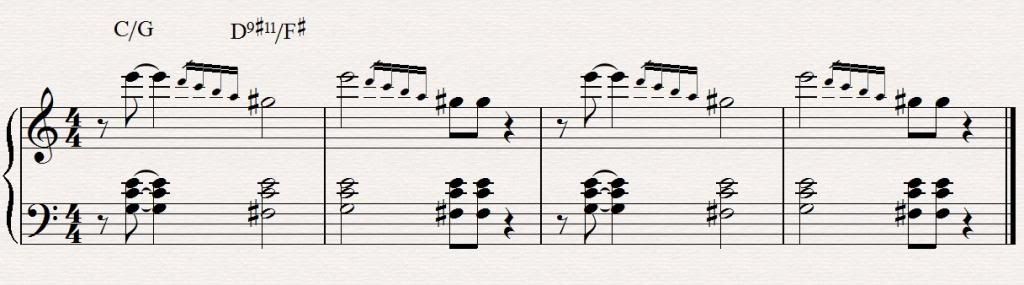
Here's a transcription of the famous 4-bar intro (click to enlarge):


It is comprised of just two chords. The first chord is a second-inversion C major chord, and the second chord can be thought of as a first-inversion D9#11 (though it lacks the root). Using an enharmonic spelling, it could also be thought of as a third-inversion Ab7#5, but the D9 interpretation seems more fitting, if slightly incorrect, considering the D7#11 chords found later in the head.

These two chords are covered by the left hand, and the right hand plays melodically above. The right hand covers the span of a minor sixth, connecting E to the G# below with a glissando. The minor sixth is notable in that it is just a half step smaller than a major sixth, which is found in the first few notes of the tune's melody (G up to E). The introduction's minor sixth, in a sense, creates tension (as does the whole-tone color produced by the #11 chord), which is subsequently resolved on bar 1 of the head.

Have a listen to Duke Ellington and his orchestra playing 'A' Train (begins at 0:12):

Related Posts Plugin for WordPress, Blogger...