Showing posts with label Tritone Substitution. Show all posts

Thursday, February 5, 2015

"West Side Score-y" Pt. 3: Tri-tones...They're Everywhere!!

Part 3

It seemed appropriate that Part 3 of this series was about the tri-tone. Even if it weren't for this numerical match-up, a post about the tri-tone seems inevitable when writing about West Side Story. Bernstein throws them into the score like I throw chocolate chips into cookie dough (excessively, perhaps, but to great effect).

Part 1 addressed something I called the "Smush Chord," and
Part 2 explored Bernstein's rhythmic stuff.
Part 3 continues, below... (read on!)

The Tri-Tone

Literally meaning "three-tones," the tri-tone is the musical interval spanning the range of three whole steps (6 half steps). Since our octave is most typically divided into 12 half steps, the tri-tone represents the octave divided exactly in half. The sonic result is a jarring, highly dissonant sound—so dissonant that history has given it the sinister nickname "diabolus in musica" (the Devil in music).

(More about the tri-tone and other intervals here.)

Melodic Appearances

  1. "Do" up to "fi." Of course, the best-known example of the tri-tone (at least, within the realm of West Side Story), is in "Maria." The interval, here appearing as an augmented 4th, is heard in the first two syllables: "Ma-ri..." 
  2. "Cha-Cha"
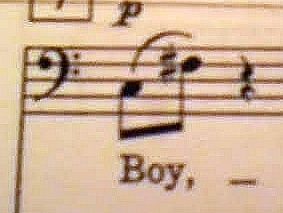
  3. "Cool" (pictured below)
  4. Basically everywhere.
from "Cool" (C up to F#, an augumented 4th)
Harmonic Appearances

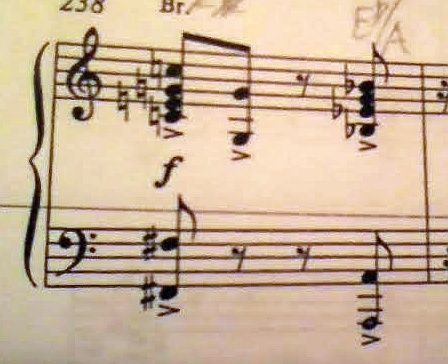
from "Prologue" [C major over F#] and [Eb major over A]
  1. Polytonal-type chords (a la Petrushka), in which a major triad is coupled with a tone 6 half steps away from the root, appear in selections such as "Prologue" (pictured above), "The Rumble," "I Have a Love," and several scene changes. In fact, the very last musical sound heard in the show is one of these puppies, with C major up high, F# down below.
  2. Major chords, with #4 (a.k.a. #11). These bright chords, which suggest the Lydian mode, can be found, among others, in "Prologue," "Jet Song," and "Gee, Officer Krupke" ("Dear...")
  3. #ii°7 diminished chords (in 3rd inversion). Closely related to the previous chord, this one is just slightly crunchier in sound. It's featured most prominently in "Something's Coming."
  4. Whole-tone spots: "Tonight" m. 37 (pictured below)
  5. Again, basically everywhere.
Pitch inventory (F, G, A, B, C#) comprised of whole tones.
(Tri-tone appears on beat 2, between F and B.)
Conclusion

To sum up (clumsily, quickly), that there are tri-tones just about everywhere in West Side Story is perhaps "needless to say," but there, I said it.

Being such a grating interval, it certainly catches the ear, and the sound sticks with you. It's what helps make the lyrical "Maria" so beautiful ("Say it loud and there's music playing / Say it soft and it's almost like praying..."), and it's what makes the show's final chord so hauntingly dissonant.

Sunday, August 19, 2012

Creston Chunks: Measure 4

[This post is part of my Personal Practice Project: Creston Chunks.]

Paul Creston's Sonata for Eb Alto Saxophone and Piano is 123 measures of interesting stuff. With (almost) no single measure repeating itself anywhere in the piece, each measure has its own special stuffsomething unique to study, analyze, and get under the fingers.

(Fortunately, there are a few motifs and harmonic ideas that show up with some frequency. For example, the piano accompaniment is comprised almost exclusively of seventh chords—primarily major-minor seventh chords.) 

With this "chunk" method, you become very well acquainted with each measure. It's almost as if each measure is its own little person with something unique to say.

Some have something interesting to say (m. 4), some have nothing to say (m. 35: a whole rest in both clefs), and some have a rather offensive message (m. 9: two sets of descending thirds, each a dissonant half step apart).

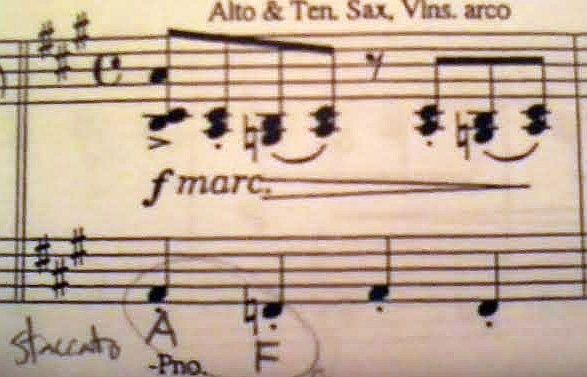
Meet measure 4 (and 5):


Essentially, measure 4 is an A7 chord. The 3rd (C#) and 7th (G) of the chord is maintained in the right hand, while the left hand covers the root (A) and the 5th (E).


In addition to featuring A7, the left hand hints at another chord. By moving a half step up from A and E, the left hand is playing Bb and Eb on beats 2 and 4. Combining these raised left hand pitches with the 3rd and 7th of the right hand, and by thinking enharmonically, we are able to derive another chord: Eb7.

So, in m. 4, both A7 and Eb7 appear. This is a great example of tritone substitution. A and Eb are separated by the interval of a tritone (an augmented 4th or a diminished 5th). The term tritone substitution refers to the fact that the two chords can easily substitute for one another. Why? Keep on reading!

When you have two dominant seventh chords whose roots are a tritone apart, something very cool happens: The 3rds and 7ths of their chords use the same pitches.

Let's look again at measure 4 to explore the tritone substitution. Thinking of A7, the 3rd of the chord is C# and the 7th is G. Now, thinking of Eb7 (beats 2 and 4, with Eb/D# being the root and Bb/A# being the 5th), Db (enharmonic to C#) is the 7th and G is the 3rd.

Put another way, the 3rd of the A7 is also the 7th of the Eb7, and the 7th of the A7 is also the 3rd of the Eb7.

This explains why the right hand is able to stay on the same notes despite the fact that two different chords are being created. Since the 3rd/7ths are shared between the two chords, it's up to the left hand to differentiate the chords by playing the root and 5th of the chords.

How exciting!

To summarize, measure 4 is pretty great. It exemplifies the tritone substitution beautifully (and it's quite fun to play).
Related Posts Plugin for WordPress, Blogger...