Showing posts with label Major. Show all posts

Friday, November 14, 2014

"West Side Score-y" Pt. 1: The "Smush Chord"

West Side Score-y

One of my current jobs is as a rehearsal accompanist for a production of Leonard Bernstein's West Side Story. This means I attend rehearsals with the singers/actors/dancers and play whichever piece of music they are working on. And that means that one night I may be teaching pitches for a new song, but on another night, I might be playing an entire dance number so that the dancers can work on their choreography along with live music.

All of this meaning: I have a lot of music to learn, and it's to the benefit of everyone involved that I learn this music very thoroughly. I'm up for the challenge! Part of this thorough learning, on my part, means that I'm analyzing some of the music theory behind Bernstein's music.

Knowing the motifs (recurring musical ideas) and harmonic structures of the music helps a great deal with learning it more efficiently and more thoroughly—at least for me, anyways!

The "Smush Chord"

I'm calling this blog series "West Side Score-y" (A Score Study of West Side Story). Hilarious, I know. This first part addresses what I am calling the "Smush Chord."

Here's what it looks like on the printed page:
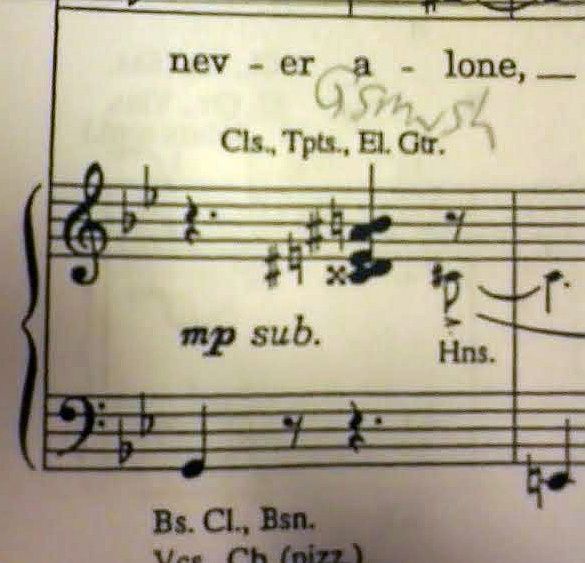
Excerpted from "Jet Song"
As you can see, the chord took a fair amount of black ink to print on the page. It's not a pretty looking thing, nor does it sound pretty.

The visual and aural harshness of the chord is part of what made me want to analyze it a bit deeper and try to wrap my head around it.

(To be honest, sometimes my instinct when seeing a chord like this, is to just smash my hand down onto the keyboard and hope for the best. This more measured, analytical approach is an effort to avoid that tactic.)


Pitch Inventory
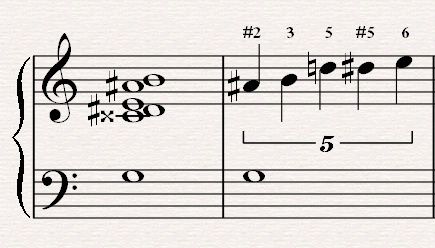

Here's the chord's pitches re-ordered according to ascending (G major) scale order. Above each note, I've attached a scale-degree label, based on the G major scale. I have used some enharmonic spellings in the analysis.

*Notice the tritone (diminished 5th) interval between A# and E. West Side Story is riddled with tritones (Think: "Ma-ri-a").


Major + Minor = Smush

I noticed that the chord's pitches can be divided into two separate groups, one of which forms a Major 6 chord, and the other of which forms a Minor chord (with a flattened 6). Keep in mind, I'm adding the bass note "G" in order to create these chords (indeed, G is the root note).
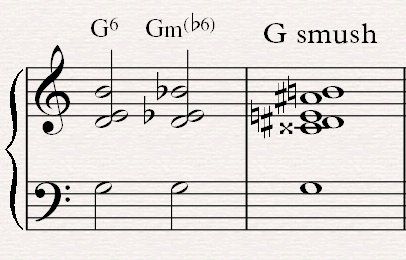

G6 + Gm(b6) = G smush
When these two chords are combined, the result is a clashing of major tonality against minor. And that, ladies and gentlemen, just sounds pretty unattractive to the ear. When I realized that this chord can be thought of as two chords superimposed, my mind leapt to the word "smush," meaning that the minor tones (minor 3rd, minor 6th) are "smushing" against the major tones (major 3rd, perfect 5th, major 6th).


Why?

Why discuss this? Frankly, because it helps. Personally, knowing where the chord tones come from, and how they relate to a familiar tonality helps me wrap my head (and my fingers) around the chord. Furthermore, I knew it was a chord worth exploring because I noticed it shows up at other places throughout the score.

More generally, the half steps (and tritones!) found within this chord are extremely characteristic of Bernstein's intensely chromatic writing throughout the musical. (More on that later.)

Stay tuned for additional installments of "West Side Score-y," which will be created the next time I run into a similarly intriguing musical morsel!

Tuesday, August 26, 2014

A Handful of Major Chord Voicings (with colorful illustrations) [Part 2 of 2]

In Part 1 of this series, the handful of major chord voicings was introduced along with an accompanying A/V example.

Now, in Part 2, each voicing will be colorfully broken down.


Color-Coding Chord Tones


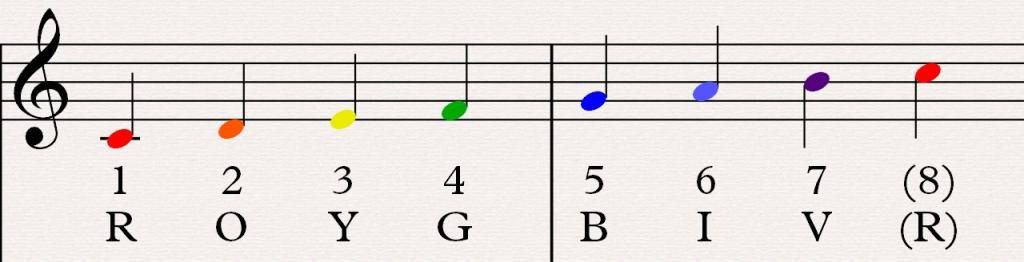
I will show each voicing notated on a grand staff, using a color-coded system. In the system, each scale degree (in these case of C major) is assigned a color, following the order of ROYGBIV. Since there are 7 notes in a scale, and 7 distinct colors in the visible light spectrum, this works out nicely. (This colorful choice of mine was inspired by this very interesting article about the link between Music and Color.)

C major scale, in colors.

*Please note that the people I attribute the following voicings to (and therefore the labels I assign each one), are by no means the originators of a particular voicing. Rather, they are the musicians/educators from whom I personally learned each voicing. (I will link to the relevant sources as we go along.)

Five Colorful Voicings


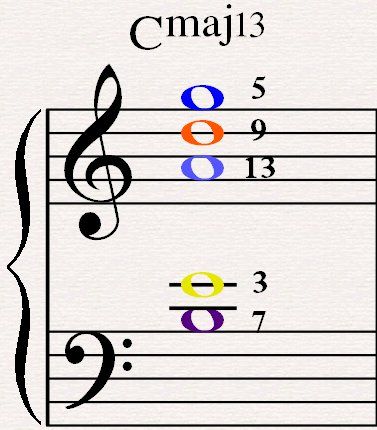
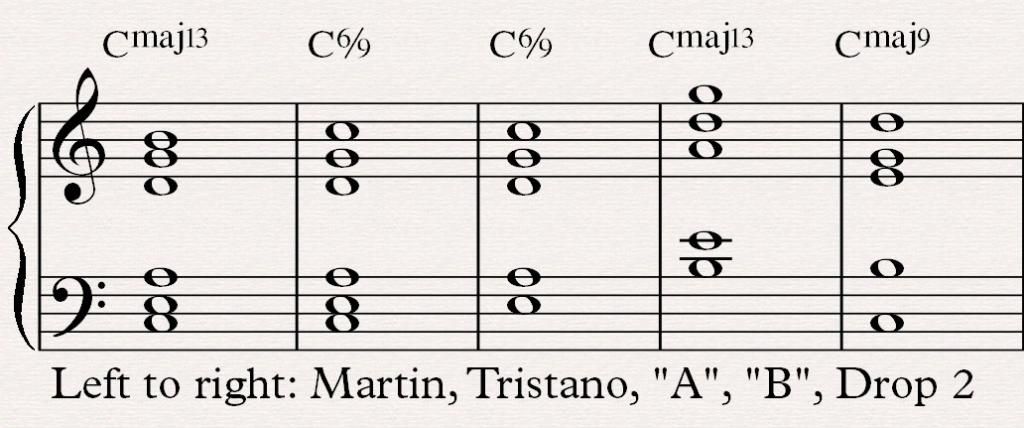
1) Symmetrical "Martin" Cmaj13 (via Peter Martin)

  • Symmetry in intervals: 3rd, 4th, 4th, 4th, 3rd
  • Very similar to the next voicing (Tristano), but more colorful because it contains the 7th
  • LH contains a minor chord in first inversion, RH contains a major chord in second inversion


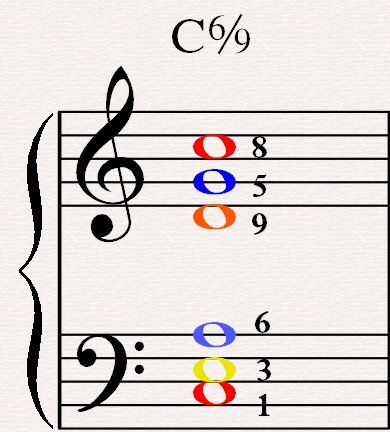
2) "Tristano" Cmaj6/9 (a la Lennie Tristano)


  • Top four notes are spaced out by a 4th
  • Root is doubled, appearing on the very bottom and top of the voicing
  • Tristano often used this by "planing" this shape, moving it up or down chromatically


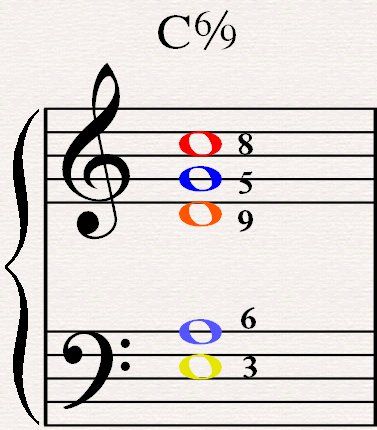
3) Rootless "A Position" Quartal Voicing, Cmaj6/9 (via Earl MacDonald)


  • 3rd on bottom (root on top)
  • Basically the same as Tristano's voicing, but without the root doubled in the LH


4) "B Position" Quartal Voicing, Cmaj13 (via Earl Macdonald)


  • 7th on bottom (5th on top)
  • Rootless


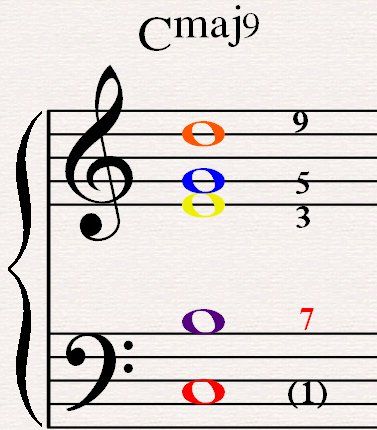
5) "Drop 2" Cmaj9


Final Remarks


What to do with all of this information? If you happen to latch on to the sound/feel of one or two of these, take a second to figure it out on the piano. Divide the notes between hands however is most comfortable to you (in some 5-note cases, it may be preferable to put three notes in the LH, two in the RH, but you might prefer it the other way around). From there, continue around the Cycle of Fourths (or Fifths), constructing the voicing slowly and carefully.

Happy voicing!

A Handful of Major Chord Voicings (with colorful illustrations) [Part 1 of 2]

Prepare yourself to play some of these pretty chords. In general, they more-or-less all share the following characteristics:

  • Mostly quartal (stacked in fourths)
  • Contain extensions such as the 6th (13th) or 9th
  • Relatively equal spacing between notes
  • Sound really great
Here they are all together on one line of music, with an accompanying video (listen for the subtle differences between each voicing):

(These labels I assigned each one will be explained in Part 2.)


In the next installment [Part 2 of 2], I will show you how to construct each of these voicings.
Related Posts Plugin for WordPress, Blogger...