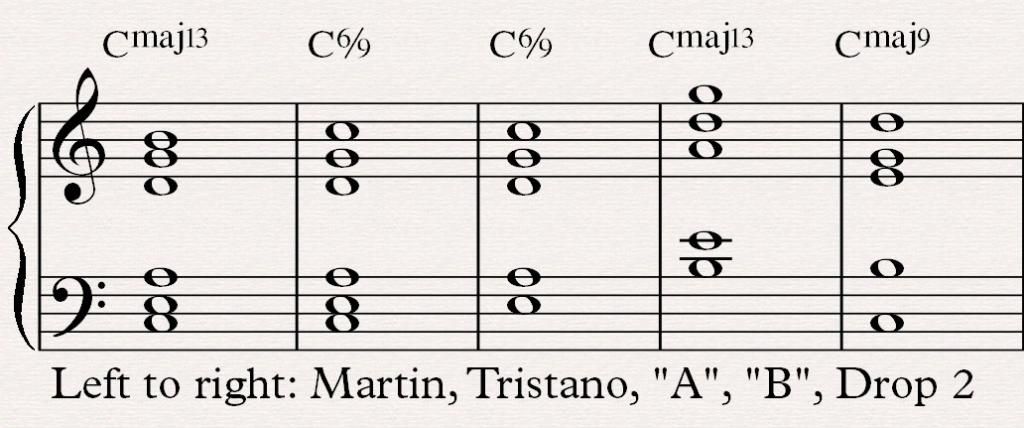
In Part 1 of this series, the handful of major chord voicings was introduced along with an accompanying A/V example.
Now, in Part 2, each voicing will be colorfully broken down.
Color-Coding Chord Tones
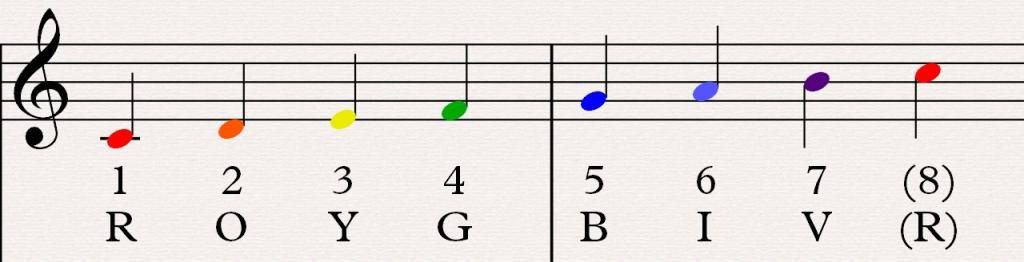
I will show each voicing notated on a grand staff, using a color-coded system. In the system, each scale degree (in these case of C major) is assigned a color, following the order of ROYGBIV. Since there are 7 notes in a scale, and 7 distinct colors in the visible light spectrum, this works out nicely. (This colorful choice of mine was inspired by
this very interesting article about the link between Music and Color.)
 |
| C major scale, in colors. |
*Please note that the people I attribute the following voicings to (and therefore the labels I assign each one), are by no means the
originators of a particular voicing. Rather, they are the musicians/educators from whom I personally learned each voicing. (I will link to the relevant sources as we go along.)
Five Colorful Voicings
1) Symmetrical "Martin" Cmaj13 (via Peter Martin)

- Symmetry in intervals: 3rd, 4th, 4th, 4th, 3rd
- Very similar to the next voicing (Tristano), but more colorful because it contains the 7th
- LH contains a minor chord in first inversion, RH contains a major chord in second inversion
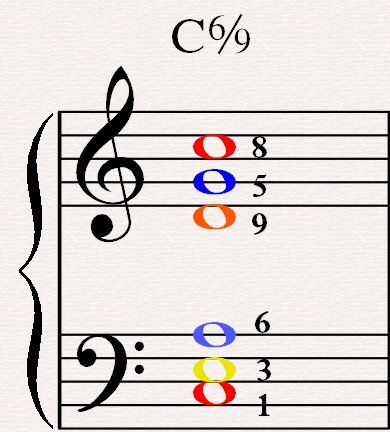
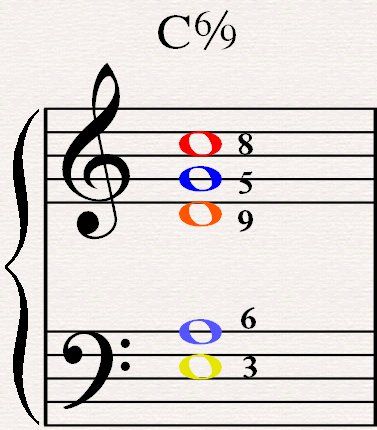
2) "Tristano" Cmaj6/9 (a la Lennie Tristano)
- Top four notes are spaced out by a 4th
- Root is doubled, appearing on the very bottom and top of the voicing
- Tristano often used this by "planing" this shape, moving it up or down chromatically
3) Rootless "A Position" Quartal Voicing, Cmaj6/9 (via Earl MacDonald)
- 3rd on bottom (root on top)
- Basically the same as Tristano's voicing, but without the root doubled in the LH
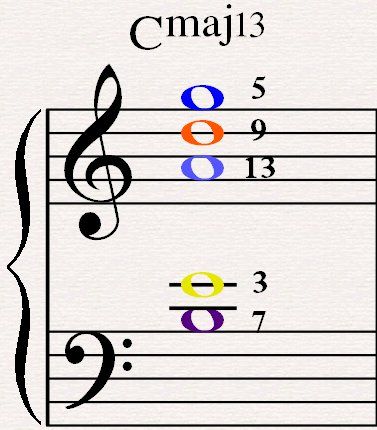
4) "B Position" Quartal Voicing, Cmaj13 (via Earl Macdonald)
- 7th on bottom (5th on top)
- Rootless
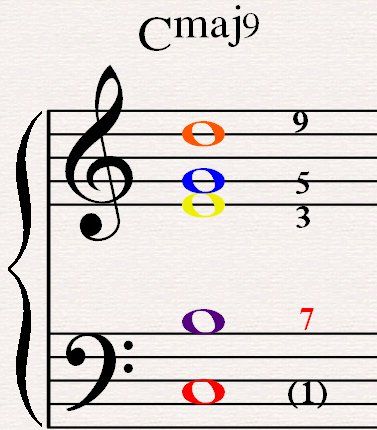
5) "Drop 2" Cmaj9
Final Remarks
What to do with all of this information? If you happen to latch on to the sound/feel of one or two of these, take a second to figure it out on the piano. Divide the notes between hands however is most comfortable to you (in some 5-note cases, it may be preferable to put three notes in the LH, two in the RH, but you might prefer it the other way around). From there, continue around the
Cycle of Fourths (or Fifths), constructing the voicing
slowly and
carefully.
Happy voicing!