Sunday, October 27, 2013

Visual Aid for Key Signatures

The visual aid

One late night I began doodling around the topic of key signatures. I had fun interweaving note names with numbers, and when I was finished, I found that I had created a musical tool that perhaps you might find handy.

The end result, in effect, is a visual fusion of a key (letter name) with its respective number of sharps or flats. Here I have posted the tool in two forms (click to enlarge each image):
  • Vertical (black and white), progressing in ascending fourths as you move from the top of the image to the bottom.
  • Circular (with color), as in the circle of fifths. As you move clockwise, you are moving up by fifths. As you move counter-clockwise, you are moving up by fourths.


Circle of fifths


 To use the visual tool...
  1. Locate your desired major key.
  2. Observe its corresponding number. This is the number of sharps/flats in a particular key.
  3. If you are in a flat key (the blue half of the circle), add that number of flats to the key signature by following the order of flats (B E A D G C F).
  4. If you are in a sharp key (the green half of the circle), add that number of sharps to the key signature by following the order of sharps (F C G D A E B).
 *Keep in mind this tool is designed for finding the key signatures of major keys. That said, it's easy enough to figure out the key signature for a minor key if you know its relative major key.
  • Relative keys share the same key signature. In the same way you and your relatives share similar DNA, relative keys share the same number of sharps/flats.
  • To go from a minor key to its relative major key, simply move up three half steps.
  • Example: To get from F minor to its relative major, walk up three half steps (F#, G, Ab). We arrived at Ab, which means the relative major of F minor is Ab major. Therefore, we can say that both F minor and Ab major have the same key signature!
**In these visuals, I included only one of the common enharmonic key spellings (Gb and F#). Other enharmonics include Db/C# and Cb/B.

If you found these visuals helpful or if you know someone who might find them helpful, please feel free to share!

Sunday, September 8, 2013

'A' Train Intro

Billy Strayhorn's composition "Take the 'A' Train" was the Duke Ellington orchestra's signature tune. The piece's introduction is instantly recognizable and prepares the listener for the rest of the classic composition.

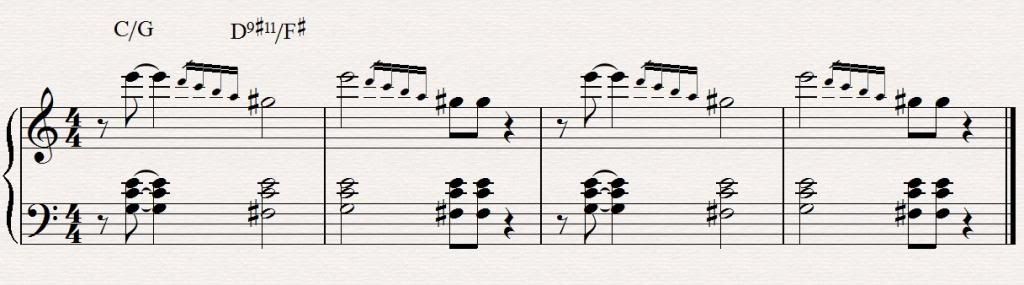
Here's a transcription of the famous 4-bar intro (click to enlarge):


It is comprised of just two chords. The first chord is a second-inversion C major chord, and the second chord can be thought of as a first-inversion D9#11 (though it lacks the root). Using an enharmonic spelling, it could also be thought of as a third-inversion Ab7#5, but the D9 interpretation seems more fitting, if slightly incorrect, considering the D7#11 chords found later in the head.

These two chords are covered by the left hand, and the right hand plays melodically above. The right hand covers the span of a minor sixth, connecting E to the G# below with a glissando. The minor sixth is notable in that it is just a half step smaller than a major sixth, which is found in the first few notes of the tune's melody (G up to E). The introduction's minor sixth, in a sense, creates tension (as does the whole-tone color produced by the #11 chord), which is subsequently resolved on bar 1 of the head.

Have a listen to Duke Ellington and his orchestra playing 'A' Train (begins at 0:12):

Related Posts Plugin for WordPress, Blogger...